
Why Finance Teams Need a Reporting Data Warehouse for Cross-System Reporting
When finance data sits across ERP systems, Excel files, entity submissions, and reporting tools, teams need more than access to the numbers. They need a structured reporting layer that turns source data into consistent finance outputs.
For many finance teams, the reporting challenge begins with the number of places data needs to come from. Core finance data may sit in Business Central, Dynamics, SAP, Sage, NetSuite, SQL, Excel, Power BI, local entity files, operational systems, or a combination of several sources. Each system may hold information that is useful on its own, and the pressure usually appears when finance needs to bring that information together into recurring outputs the business relies on.
Those outputs may include management accounts, board packs, consolidation reports, budget reports, forecast packs, variance analysis, entity-level reporting, dashboards, or planning views. The work behind them often requires finance to collect data, check it, map it, apply reporting logic, manage versions, review adjustments, and prepare a final view that can be trusted by leadership.
A reporting data warehouse gives finance teams a more structured way to manage that work. It creates a controlled layer between source systems and finance outputs, so data from different places can be collected, shaped, mapped, and used in reporting, consolidation, budgeting, forecasting, and planning processes with more consistency.
The cross-system reporting problem
Most growing organisations use more than one system to support finance reporting. An ERP may hold transactional data, Excel may support budget inputs, Power BI may support dashboards, local entities may submit files, and operational systems may hold customer, project, product, payroll, stock, or non-financial data that still matters to finance.
That setup can work well for years when the business is smaller, the same people understand the reporting model, and the required outputs follow a familiar pattern. As the organisation adds entities, changes ERP, increases reporting frequency, expands planning requirements, or receives more detailed questions from leadership, the reporting process often needs a more supported structure around it.
The pressure usually shows up in practical places. Files need to be exported again. Mappings need to be checked again. A spreadsheet needs to be rolled forward again. Entity submissions need to be copied into a group file again. A number in the board pack needs to be traced back through several tabs, extracts, or source systems before finance can explain what changed.
These steps may be manageable individually, and together they can create a reporting cycle that takes more coordination, manual handling, and individual file knowledge than the team wants to carry every month or quarter.
What a reporting data warehouse does
A reporting data warehouse brings data from multiple sources into a shared structure designed for reporting and analysis. For finance teams, the value sits in how that data is prepared for the recurring outputs they need to produce.
This may include mapping different charts of accounts into a group reporting structure, applying consistent entity and department logic, supporting currency translation, maintaining historical data, aligning budget and actual data, and creating a foundation for management reports, board packs, dashboards, and planning outputs.
When the reporting data warehouse is built around finance requirements, it becomes part of the operating structure behind the finance cycle. The same logic can be applied each month, quarter, or year, which makes the process easier to repeat, investigate, and expand as reporting needs change.
Why ERP data needs a reporting structure around it
ERP systems hold important transactional data, and finance teams often need an additional reporting layer when management reporting, consolidation, budgeting, forecasting, and analysis require information to be shaped across several sources.
A finance team may need to consolidate entities using different systems, compare actuals from the ERP with budgets prepared through a separate process, report by management dimensions that are not fully reflected in the source system, or combine financial and operational data into one view. During an ERP change, the team may also need to preserve reporting continuity when historical data sits in one system and current data sits in another.
This is where the reporting layer becomes important. The ERP holds the transactions, and the reporting data warehouse helps turn those transactions into the reporting, consolidation, budgeting, and forecasting structures finance needs to run recurring cycles.
For organisations using Business Central, Dynamics, SAP, Sage, NetSuite, or a mix of systems, this layer can become especially valuable when the business needs group reporting, board packs, multi-entity consolidation, forecast reporting, or analysis that draws from more than one source.
Where cross-system reporting creates pressure
Cross-system reporting often becomes more difficult in group structures where multiple entities feed into one finance process. Each entity may use different account codes, reporting timelines, local files, currencies, approval steps, or supporting schedules. Group finance then needs to collect the information, check it, map it, consolidate it, and prepare the final output.
The same pattern appears in budgeting and forecasting. Actuals may come from the ERP, assumptions may come from department heads, forecast inputs may arrive through spreadsheets, and final outputs may need to appear in a board pack, dashboard, or management reporting format.
A reporting data warehouse gives finance a defined place where source data can be aligned to the reporting structure. Actuals, budgets, forecasts, entity inputs, and supporting data can feed into a more consistent model, which reduces the amount of repeated handling required before finance can begin reviewing the numbers.
Why this matters for consolidation
Consolidation is one of the clearest examples of where a reporting data warehouse can support finance. When several entities feed into group reporting, finance needs a process that can support entity-level inputs, account mapping, adjustments, FX, intercompany items, eliminations, and group-level reporting views.
When this work is handled across several spreadsheets and extracts, the process can become harder to review and support. The final report may be consistent, and the work behind it can still depend on copied values, workbook links, manual adjustments, supporting notes, review emails, and individual knowledge held outside the main reporting structure.
With a reporting data warehouse in place, consolidation can be built around defined data flows and reporting logic. Entity data can feed into a central model, mapping can be applied consistently, and finance can work from a structure that supports both the group output and the detail behind it.
Why this matters for budgeting and forecasting
Budgeting and forecasting also benefit from a structured reporting data warehouse because these processes rely on both historical data and future inputs. Finance teams often need actuals from the ERP, assumptions from the business, input from departments or entities, and reporting outputs that compare plan, forecast, and actual performance.
When those elements are managed across disconnected files, the planning cycle can require a large amount of preparation before meaningful review can begin. Every forecast may involve exports, updates, checks, links, input files, and version control before finance has a usable view.
A reporting data warehouse can reduce that preparation effort by creating a more consistent foundation for actuals, budgets, forecasts, and reporting views. This can make it easier to roll actuals into the forecast process, collect inputs in a defined structure, and produce outputs that can be compared across cycles.
Why this matters for management reporting
Management reporting often requires finance to combine accuracy, timing, context, and presentation. A report may need to show performance by entity, region, department, project, cost centre, customer, product, or another management dimension that cuts across the way source systems were originally configured.
When the reporting process depends on separate files and manual preparation, every new view can create extra work for the finance team. A leadership question may require another extract, another lookup, another adjustment, or another version of the report.
A reporting data warehouse can support management reporting by giving finance a structured foundation for repeatable outputs and supporting detail. Reports can be built from a shared model, and drilldown can help finance investigate numbers without rebuilding the reporting view from the ground up.
The role of finance-led implementation
The value of a reporting data warehouse depends on how well it reflects the finance process it needs to support. Data extraction is only one part of the work, because finance also needs the right account structures, mappings, dimensions, reporting logic, input processes, review steps, and output formats.
This is where implementation knowledge matters. Finance teams need data shaped around management reporting, consolidation, budgeting, forecasting, planning, FX, intercompany, board packs, and recurring review cycles. The structure needs to reflect the way the organisation reports and the way the finance team needs to support those reports over time.
Solver Ireland’s role is to help finance teams structure these recurring processes inside Solver. The client brings the finance context, the outputs they need, and the way the business needs to report. Solver Ireland brings the platform, finance-led implementation experience, local support, and delivery knowledge built from real reporting, consolidation, budgeting, and forecasting projects.
How Solver supports cross-system reporting
Solver’s cloud-based Corporate Performance Management platform can support reporting, consolidation, budgeting, forecasting, planning, dashboards, and analysis from a shared finance structure. For cross-system reporting, the data warehouse layer helps bring data from different sources into a model that finance can use for recurring outputs.
This can include ERP data, Excel-based inputs, entity submissions, budget data, forecast data, and other relevant sources, depending on the client’s setup and implementation scope. Once the structure is in place, finance teams can use the same platform to support reports, consolidation views, planning processes, drilldown, dashboards, and future expansion.
For many organisations, the first phase may focus on the process under the most pressure, such as management reporting, consolidation, board packs, or forecast reporting. Once the reporting structure is established, the same platform can support wider budgeting, forecasting, planning, and analysis requirements over time.
What finance teams gain from a structured reporting layer
A reporting data warehouse gives finance teams a more supported foundation for the outputs they already produce. It can reduce repeated manual handling, improve consistency across reports, support traceability, and make recurring finance cycles easier to maintain.
It can also reduce key-person dependency by moving logic, mapping, structure, and reporting outputs into a platform that can be supported by more than one person. This protects the knowledge that already exists in the finance team and makes the process easier to hand over, review, adjust, and expand.
The strongest value appears in the next recurring cycle. Month-end reporting becomes easier to repeat because the structure behind the reports is more consistent. Consolidation becomes easier to review because entity inputs and mappings sit in a defined process. Forecasting becomes easier to update because actuals and planning data can work from the same foundation. Board packs become easier to investigate because finance has a clearer route from the summary number to the supporting detail.
A practical starting point
For finance teams considering whether they need a reporting data warehouse, the best starting point is the current reporting process. It is useful to map where data is exported, copied, adjusted, mapped, reviewed, approved, or handled more than once.
It is also useful to identify where the process depends on individual file knowledge, where source systems do not align neatly with finance outputs, where entity inputs are difficult to control, and where reporting questions require finance to move through several files before an answer can be found.
These areas often show where the organisation would benefit from a more structured reporting layer around the systems it already uses.
Bringing cross-system reporting into a finance structure
Cross-system reporting becomes easier to support when finance teams have a defined structure between source data and final outputs. A reporting data warehouse gives that structure a practical foundation, especially when reporting, consolidation, budgeting, and forecasting need to draw from multiple systems, files, entities, and input processes.
Solver Ireland helps finance teams build that structure inside Solver, using finance-led implementation expertise, local support, and a platform that can support recurring reporting and planning cycles as the business grows.
For finance teams managing ERP data, Excel inputs, entity submissions, reporting tools, and recurring management outputs, the useful question is whether the team has the right structure to turn that data into consistent outputs every month, quarter, and year.
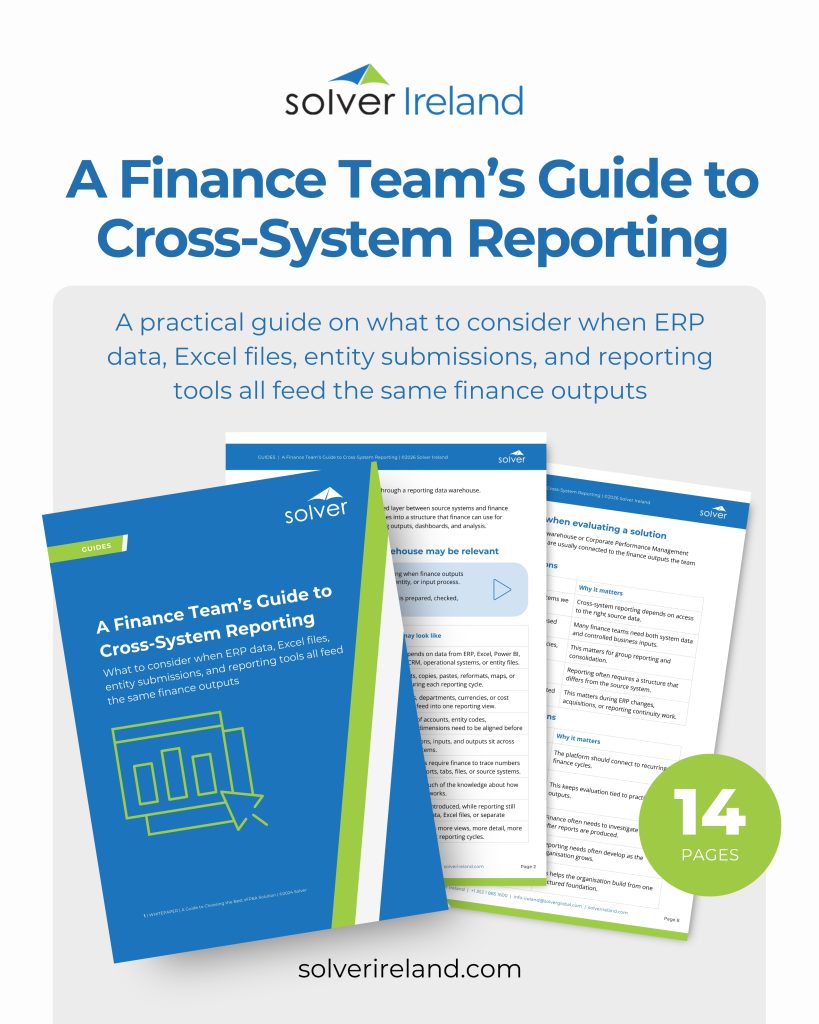
To explore this further, download A Finance Team’s Guide to Cross-System Reporting for a practical look at what to consider when ERP data, Excel files, entity submissions, and reporting tools all feed the same finance outputs.